Pour-Over Kettles and the History Behind the Gooseneck Spout
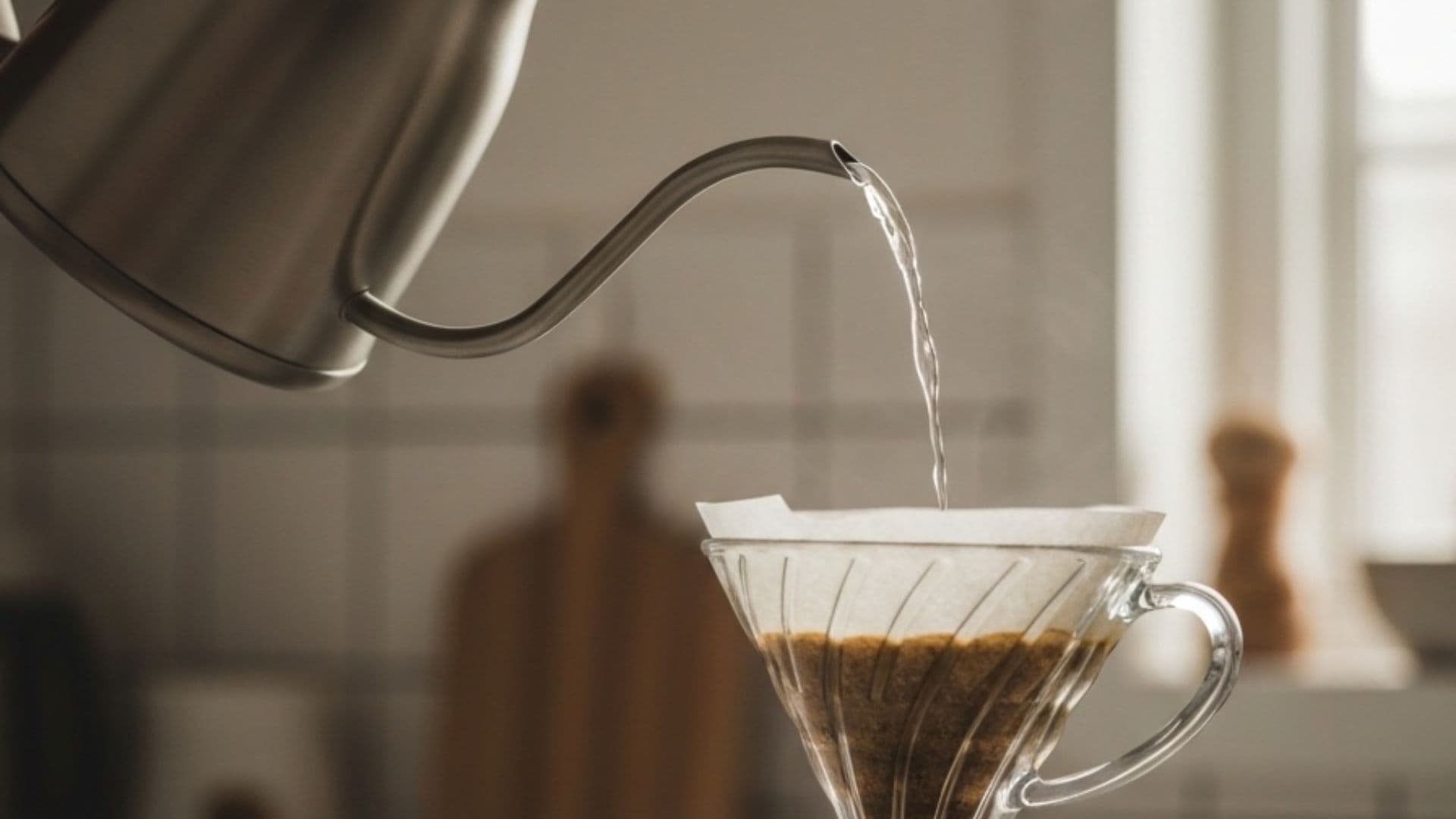
Pour-over begins in 1908, when Melitta Bentz pierced holes in the bottom of a brass pot, laid a sheet of blotting paper from her son's school notebook over them, and registered the result with the German patent office. The kettle came afterwards, because the method created the problem the kettle exists to solve. Water has to arrive slowly and evenly, and a wide spout ties the rate of the pour to the angle of the kettle. The narrow, curved spout was already in use on tea and water kettles by then. Nobody is documented as having invented it for coffee, and the tidy origin stories that name a particular Tokyo bar or a particular metalworker do not survive checking. What is documented is where it became standard practice: Japan's coffee houses, where slow hand pouring was treated as a discipline and the fine-spouted kettle was the tool for it.
What the shape actually does is simple: it decouples the angle of the kettle from the rate of the pour. A wide spout ties those two things together, so tipping far enough to get water moving also means getting more water than you wanted. A gooseneck lets you tip the kettle well past the point a normal spout would be dumping, while the water still comes out as a controlled, narrow stream. That's the whole trick. Everything else, the handle shape, the finish, the weight, is secondary.
This matters for pour-over specifically because even saturation is most of what separates a good cup from a mediocre one. Coffee grounds want to be wetted at roughly the same rate across the whole bed. Pour too fast in one spot and you get channeling, where water finds the path of least resistance through the grounds and rushes past most of the coffee untouched, while the rest gets essentially no contact. The result is a cup that's simultaneously under-extracted (sour, thin) and over-extracted (bitter) depending on which grounds the water actually touched. A controllable, narrow stream lets you move it in slow circles and keep the bed evenly wet.
Where the quality cliff sits: a $20 gooseneck kettle and a $200 one control pour rate about the same well past the point it matters. What the expensive ones buy you is temperature stability (an electric kettle with a hold function beats a stovetop kettle cooling as you pour), a more comfortable handle for a five-minute pour, and in a few cases, a genuinely finer spout tip for people making very small, precise adjustments. None of that touches the actual mechanism that makes pour-over work. A $35 stainless gooseneck and careful technique will out-brew a $250 one used carelessly, every time.
The one place spending more clearly helps is temperature control, not the spout. If you're brewing multiple cups in a session and the water's cooling between pours, an electric kettle that holds a set temperature removes a real variable. That's a legitimate upgrade. A fancier spout profile past the basic gooseneck shape is not.
Where it came from
- 1908
Melitta Bentz patents the paper filter
A Dresden housewife pierces holes in a brass pot, lays blotting paper from her son's school notebook over them, and registers the filter with the German patent office on 20 June 1908. Pour-over as a method starts here. The kettle question follows from the method rather than the other way round.
Source: German Patent and Trade Mark Office, on Melitta Bentz's filter
- Older than its coffee use
The shape came from tea
The narrow, curved spout was on tea and water kettles long before anyone aimed one at a bed of coffee grounds. No individual is documented as having invented it for coffee, and the accounts that credit a specific Tokyo bar or a local metalworker in a specific year do not hold up when checked. This entry exists to say so, because an origin story with a name and a date in it is more memorable than the truth and worth resisting for that reason.
- Post-war Japan
Kissaten culture makes it the standard
Japan's coffee houses treated slow hand pouring as a discipline, and the fine-spouted kettle became the tool for it. Takahiro, in Tsubame, the Niigata city built on stainless steel and metalworking, is the reference example with its Shizuku series. Sources disagree on when the company began making them, so no year is claimed here.
- c. 2008
The kettles reach North America
Pour-over takes hold in North American specialty coffee around 2008, and the Japanese kettles arrive alongside it. The shape had been in working use for decades by then, which is why it appeared fully formed rather than evolving in front of a Western audience.
How it is made
Even saturation is most of what separates a good cup from a mediocre one. The grounds want to be wetted at roughly the same rate across the whole bed, and the kettle is the only tool in the chain that controls that.
Pour-over kettle
What to buy
Recommendations rest on verifiable specifications: spout geometry, flow rate, thermal mass and temperature-hold behaviour. We have not brewed with these kettles. This tells you which features change the cup, not which kettle won a bake-off — any stainless gooseneck meeting the stated specification qualifies.
A plain stainless gooseneck, no electronics
The spout is the entire mechanism, and a twenty-dollar gooseneck controls pour rate about as well as a two-hundred-dollar one well past the point it matters. Careful technique with a thirty-five-dollar kettle out-brews a two-hundred-and-fifty-dollar one used carelessly, every time.
An electric kettle that holds a set temperature
The one place more money buys something real, and it is not the spout. Brewing several cups in a session means the water cools between pours, which is a genuine variable. Holding temperature removes it.
A finer spout profile past the basic gooseneck shape
Once the spout decouples the angle of the kettle from the rate of the pour, it has done its job. Refinements beyond that are refinements to a problem already solved, and they do not touch the mechanism that makes pour-over work.
- How this was made
- Recommendations rest on verifiable specifications: spout geometry, flow rate, thermal mass and temperature-hold behaviour. We have not brewed with these kettles. This tells you which features change the cup, not which kettle won a bake-off — any stainless gooseneck meeting the stated specification qualifies.
- Sources
- 4 consulted, 4 primary
- Price bands
- Editorial judgement, not a formal price survey.
- Fact-check
- Passed
- Standards
- Passed
- Edited & approved
- Josh Perry, July 28, 2026
- Corrections
- 1 issued